Bury Your Tropes, Not Your Gays

Noelle Stevenson’s Nimona is a refreshing twist on queer literature.

For as long as queer authors have existed, so has queer coding as a way of putting queer characters in their books without having to face the associated backlash. In more restrictive times, authors had to be very careful about what they tried to publish and relied largely on subtle references to stereotypes and coded slang from queer communities. Now that homosexuality is no longer illegal and queerness of all kinds is becoming more widely accepted, authors are able to be more bold in the way they code their characters as queer. Many authors simply skip over coding and make their characters explicitly queer. Others, like Noelle Stevenson, use a combination of queer coding and explicit queerness to appeal to a variety of audiences on a variety of levels. Today, queer coding often gets a bad rap, because writers tend to most obviously queer code villains (looking at you, Disney), which perpetuates negative stereotypes about queer people. But any character–good, bad, or morally ambiguous–can be coded as queer.

Every main character in Stevenson’s graphic novel Nimona is queer coded, hero and villain alike. Actually, the three main characters are all some combination of hero and villain, which defies the queer villain trope right off the bat through lack of villain to queer code. Nimona is all about subverting tropes of all kinds. She subverts the queer ones rather neatly; she doesn’t have queer-coded villains, all the characters have well-rounded personalities, none of the queer characters die, and the same-sex romance is written just as multifaceted and enduring as any straight romance. All of these sum up to make an all-around smashingly good (there’s a lot of smashing on Nimona’s part) graphic novel that gives the reader a refreshing break from the tropes that pervade so much of queer literature.
(cover)

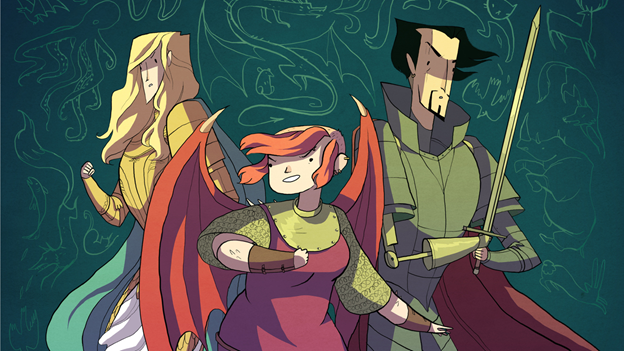
Nimona is the title character of the book; she’s a badass shapeshifter with a dark and mysterious past who loves wreaking havoc and hates scary movies. Her hair is short, unnaturally colored, and partially shaved, all trademark looks for modern queer women. She also has several piercings, another common look for queer people of all genders. Although Nimona’s sexuality is never mentioned, she’s drawn to look queer. Her appearance is also fluid, as evidence from the very beginning by her dragon wings on the cover. She changes shapes, sizes, species, and even genders, depending on what the situation calls for. She transforms into a huge, brutish man to carry her friend and fellow “villain” Ballister Blackheart’s heavy chest before they rob the bank (60-61), she transforms into Blackheart himself (34), and she even spends a day as a little boy named Gregor when she and Blackheart go to the Science Expo (103). But even as she transforms, she keeps her identity as a woman, including female pronouns (she/her). When Blackheart comments on how heavy she is to carry as a little boy, she responds that “It’s rude to comment on a lady’s weight” (106). Nimona may look like a boy, but she still identifies as a girl, which codes her as transgender and offers a mirror in which trans people can see themselves represented. Fortunately, unlike too many trans-coded characters throughout film and literature, Nimona and her gender representation aren’t the butt of anyone’s jokes.

Ambrosius Goldenloin is the “hero” of the story. He wears golden armor and works for the Institution of Law Enforcement and Heroics. But Stevenson is never one to follow well-known tropes, so instead Goldenloin, even though he calls himself a hero, is the damsel in distress. He’s oblivious to his role as a pawn in the Institution’s evil plots, and he’s easily injured and defeated in a fight. He’s also extremely effeminate. He has long, blond hair—blond hair is considered more feminine than brunet—his outfit resembles a flowy skirt, his body language oscillates between flamboyant (7) and meek (15), and he has an hourglass figure (45). All of these traits feminize Goldenloin, and as a man, that codes him as queer, even without the implied romance between him and Blackheart, Goldenloin’s former best friend/current nemesis. Blackheart is the nominal villain of the story, but of all the characters, he proves to be the most morally upstanding. He, like Nimona, has pierced ears and a partially shaven head; piercings and alternative hairstyles are common physical markers of queerness in men just as much as in women.

Throughout the story, Stevenson implies that frenemies Blackheart and Goldenloin have some kind of mutual romantic feelings for one another. She gives clues to their relationship, like a single moment of handholding when they meet clandestinely at a tavern (94) and Goldenloin’s subtle flirting during a fight scene (13), but nothing is explicitly stated until Blackheart, at a time of overwhelming desperation, calls Goldenloin “someone I love” (214). This moment makes their romance explicit, thwarting the expectation of queer baiting, a trope in which writers code two characters of the same gender as potential lovers but never follow through. Blackheart and Goldenloin’s relationship stands up to the test of time, enmity, and the forces of evil. Unlike countless ill-fated and “equal parts temporary and shameful” (Waters). Not only do they both survive—subverting the despicable “bury your gays” trope—they both live happily ever after, an ending that not many same-sex couples get.

Stevenson does an excellent job of representing a variety of types of queer people and their relationships and avoiding harmful stereotypes while she does it. Simply putting queer characters in a book is not enough anymore; these characters need to exist as more than just a set of stereotypes and victims to harmful tropes. Stevenson does an excellent job of subverting these tropes by making her characters well-rounded, queer coding everyone except the true villain of the story–the Director–treating characters’ identities seriously, showing a long-lasting same-sex relationship, and best of all, not killing off any of her queer or queer-coded characters. If all these subverted tropes aren’t enough, Stevenson also has a field day subverting all kinds of fairy tale tropes, too. Overall, Nimona is a spectacular book all around for anyone–like me–who is tired of the same old tropes in every story.

Works Cited

“Queer coding.” LGBT Fiction Guide, 21 Mar. 2017, http://lgbtfiction.com/index.php?title=Queer_coding. Accessed 13 Dec. 2018.

Stevenson, Noelle. Nimona, HarperCollins, 2015.

Waters, Michael. “A Brief History of Queer Young Adult Literature.” The Establishment, 3 Aug. 2016, medium.com/the-establishment/the-critical-evolution-of-lgbtq-young-adult-literature-ce40cd4905c6. Accessed 29 Nov. 2018.

The Hunger Gay-mes

Suzanne Collins’s The Hunger Games is queerer than you think

As any queer person knows, it’s hard to find good representation in popular literature. It’s getting better, thankfully, but most of the time, the latest greatest book that everyone loves has maybe one gay character in it, and he’s closer to a bunch of stereotypes stacked in a trench coat than an actual person (he’s always a guy, too). That is not to say that well-written queer characters don’t exist in literature, or even in popular literature, but they’re definitely not the norm, which leaves readers like us scouring every page for every little bit of subtext and queer coding we can find. The Hunger Games by Suzanne Collins is no exception to this rule,but it doesn’t even have a gay side character. What is does have is a lot of queer coding.

First of all, what is queer coding? Today, the term has taken on a negative connotation, since we often see it applied to fictional villains.Disney, for example, is the master of queer-coded villains—Ursula from The Little Mermaid is literally designed after a drag queen named Divine (“Queer coding”). But at its core, queer coding is a neutral device that allows writers to subtly signal to their audiences that a certain character is gay without having to say it explicitly. Historically,this was a great way for authors to put queer characters in their works and still get published, due to restrictions on books and movies like the Hays Code, which forbade explicit depictions of homosexuality in Hollywood in the mid-20th century. Today, when no such restrictions exist, the device has largely turned into a way for authors to retroactively point to queer-coded characters as examples of representation without having to actually write queer characters (remember Dumbledore?). Queer coding often relies on stereotypes,like effeminate men, masculine women, and lots of hidden rainbows.

All of that being said, sometime queer coding is the best we’re going to get while trying to read all the cool, hip books that everyone seems to be talking about, like The Hunger Games. For a book that doesn’t include any explicitly queer characters, The Hunger Games is a pretty good read. Collins manages to avoid falling into the common practice of only queer coding villains,and she neatly sidesteps the gratuitous love triangle plot that Young Adult(YA) authors seem to love so much.

The Capitol, as we are first introduced to it through Katniss’s eyes, is gayer than a Christmas song. It’s just about on the level of a New York City Pride parade, and Collins isn’t even subtle about it. Katniss and her hunting buddy Gale joke about what life in the Capitol must be like in the woods surrounding District 12, but her first glimpse of it leaves her awestruck at “the glistening buildings in a rainbow of hues…, the oddly dressed people with bizarre hair and painted faces,” and the garishly dazzling colors—“the pinks too deep, the greens too bright, the yellows painful to the eyes” (59). Garish colors, painted faces, bizarre hair, and shiny rainbows are all defining characteristics of the Capitol—and of any Pride parade, festival, gay club, or drag show in existence.

The glitz and glam aren’t what code the Capitol as a gay heaven; it’s the femininity of it all. All those hallmarks of queerness are traditionally feminine. Makeup, shiny things, bright colors, and styled hair are for women; any man who partakes in them is crossing gender boundaries and therefore queer. This may seem hypocritical, since women are free to partake in masculine aesthetics like pants and dull colors, but consider that our society sees masculinity as the default. Femininity is seen as an extra level of performance on top of that,and over-the-top femininity, like you see in drag queens, is even more extra. In the Capitol, that drag-queen level of extra is the default, which leaves everyone, even the women, looking like a contender for Ru Paul’s Drag Race.

This may sound like Collins is queer coding her villains,since everyone knows the Capitol represents the “bad guy” of the book. But, I direct your attention to Cinna and Effie, two Capitolites who may be part of the Hunger Games franchise but are also on Katniss and Peeta’s side. Both Cinna and Effie take part in the fashion styles of the Capitol. Cinna is more reserved in his style, but he does still wear a bit of glam. Fellas, is it gay to wear metallic gold eyeliner to bring out the flecks of gold in your green eyes (63)? Cinna says no, but our society says yes, which leaves him coded as queer, just like the rest of the Capitol. Effie, on the other hand, goes all out; she dresses like a cross between a pre-Revolutionary French aristocrat and a drag queen. Her hyper-femininity, even though she’s a woman, codes her as queer, too.

Leaving behind the evil and morally gray characters, Katniss is also queer coded, just in the opposite manner of the inhabitants of the Capitol. Instead of hyper-femininity, Katniss embraces more of a masculine presentation. She’s the patriarch of her family. She hunts—the quintessentially manly pastime—she scavenges, and she trades for resources to provide for her family. Bringing home the bacon has always been the man’s job, but with the only man in her family gone, Katniss takes over that role. When her sister, Prim’s, name is called for the Hunger Games, Katniss protects her by “going into battle” for her—an “iconically paternal” gesture (Berlatsky). Even as she embraces masculinity, Katniss also rejects traditionally feminine roles like nursing. In stark contrast to Prim and her mom, Katniss is incredibly squeamish when it comes to injuries and illnesses. By her own admission, “’killing things is much easier’” than tending to people’s wounds (258), another example of Katniss simultaneously rejecting femininity and embracing masculinity, which queer codes her.

In contrast to both the Capitol and Katniss, Peeta is queer coded by taking on femininity in his own way. First of all, he’s a baker. Not only that, but he also decorates the cakes, and uses that skill to hide in the underbrush of the forest when he’s injured. It’s a useful survival skill, but still a feminine one. Speaking of his injury, it leaves him as a damsel in distress waiting to be saved by Katniss. A tip for finding queer coding—any man (or boy, in this case) who ends up as a damsel in distress is coded as at least a little bit queer.

Most of the queer coding in The Hunger Games is about gender because there are so few references to sexuality—which is another aspect of the book I like. While there is a hint of romance between Katniss and Peeta, it’s all a performance for the sponsors on Katniss’s part. The whole time, it’s only to keep Peeta alive and later, to keep both of them safe. “If I want to keep Peeta alive, I’ve got to give the audience something more to care about…Romance” (261). Here’s where it gets meta—this is Collins’s critique of romance plots that make YA (or any genre of fiction) novels popular. By the end, Katniss still hasn’t fallen in love with Peeta—or Gale, for that matter—which falls right in line with her desire to never get married or have kids. The Hunger Games may not have any gay romances, but it doesn’t have any straight ones either, which is a refreshing breather from the love plots that feel inescapable in popular literature.Even better, the lack of romance is because the main character doesn’t want romance, now or ever. Of course,that changes as the series progresses with the next books, but for the span of The Hunger Games, it is nice to read a story about a butch aromantic girl, an effeminate guy, and their flamboyant semi-allies in their quest of rebellion, even if none of it is explicit.

Works Cited

Berlatsky, Noah. “The Hunger Games world is no country for glamorous women.” The Guardian, 30 Nov. 2015, http://www.writing-world.com/freelance/asenjo.shtml. Accessed 13 Dec. 2018

Collins, Suzanne. The Hunger Games, Scholastic, 2008.

Dart, Chris. “Read this: How Divine inspired Ursula the Sea Witch.” The A. V. Club, 19 Jan. 2016, https://news.avclub.com/read-this-how-divine-inspired-ursula-the-sea-witch-1798243255. Accessed 13 December 2018.

“Queer coding.” LGBT Fiction Guide, 21 Mar. 2017, http://lgbtfiction.com/index.php?title=Queer_coding. Accessed 13 Dec. 2018.